
GM, Miles here!
I want to make a case for what I believe is the most underrated metric in Google Ads: Lifetime Value (LTV) and how it’s the ultimate flywheel to take your results to the next level.
It’s not new, but there are still too many specialists and businesses obsessing over cost per acquisition while completely ignoring what happens after that first purchase.
Not factoring LTV into your strategy is a mistake.
When you apply LTV correctly, it changes how you acquire customers and how profitably you can grow.
Let’s dive in!
A few definitions before we get started
First, let me clarify some terms:
- LTV (Lifetime Value): How much total profit (!) a customer generates over their entire relationship with the business. Most people measure this in revenue, but it’s better to define it in gross profit.
- CAC (Customer Acquisition Cost): How much you spend to acquire a customer.
- LTV:CAC Ratio: The relationship between what a customer is worth and what you paid to get them. A 3:1 ratio means for every €1 you spend on acquisition, you get €3 back in customer value (again: profit).
Simple concepts with a massive impact on strategy and results.
Two ways to grow a business (and why LTV is the flywheel that accelerates it)
The biggest lesson I’ve learned from Alex Hormozi is that at its core, a business can only grow in two ways:
- Acquire more customers
- Make those customers worth more
That’s it. Everything else is a variation of these two levers.
Most Google Ads Specialists only focus on #1: getting more customers within a target CPA/ROAS.
But that’s a huge missed opportunity. Here’s where LTV comes in: if you make your customers worth more, you can afford to pay more to acquire the next ones.
And that’s the LTV Flywheel:
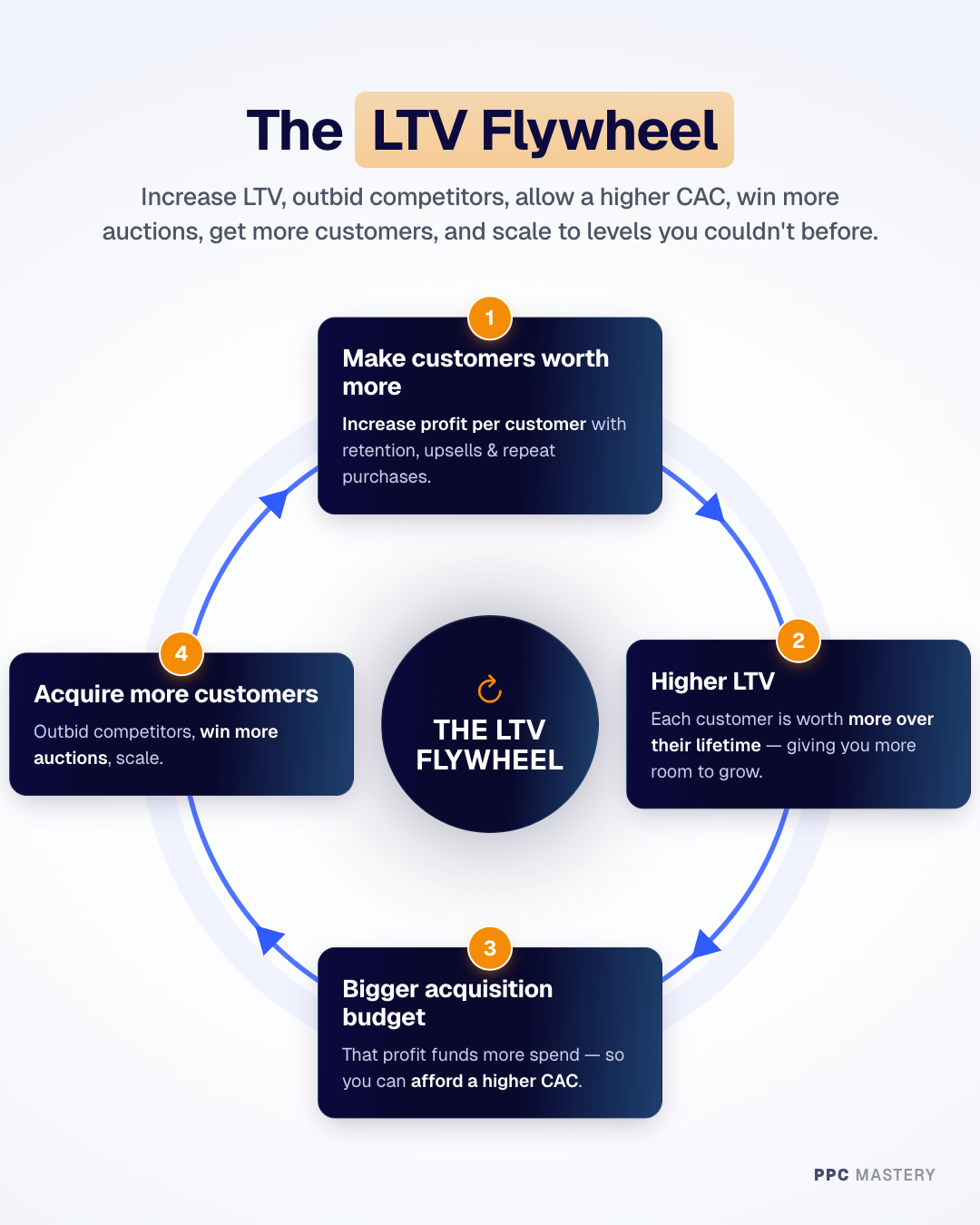
Make customers worth more → afford a higher CAC → outbid competitors and win more auctions → acquire more customers → more profit to reinvest → make customers worth more → repeat.
Every turn feeds the next. Raise your LTV and suddenly you can bid more than before, win auctions you used to lose, and still put more profit in your pocket.
LTV is the key to better returns on ad spend and truly accelerates growth like nothing else.
But most Google Ads Specialists still ignore it and feel like it’s not their responsibility because it happens outside the ad interface.
LTV determines how hard you can push to acquire customers
Here are two scenarios where the same business with the same margins can have vastly different results, simply by incorporating LTV into their acquisition strategy:
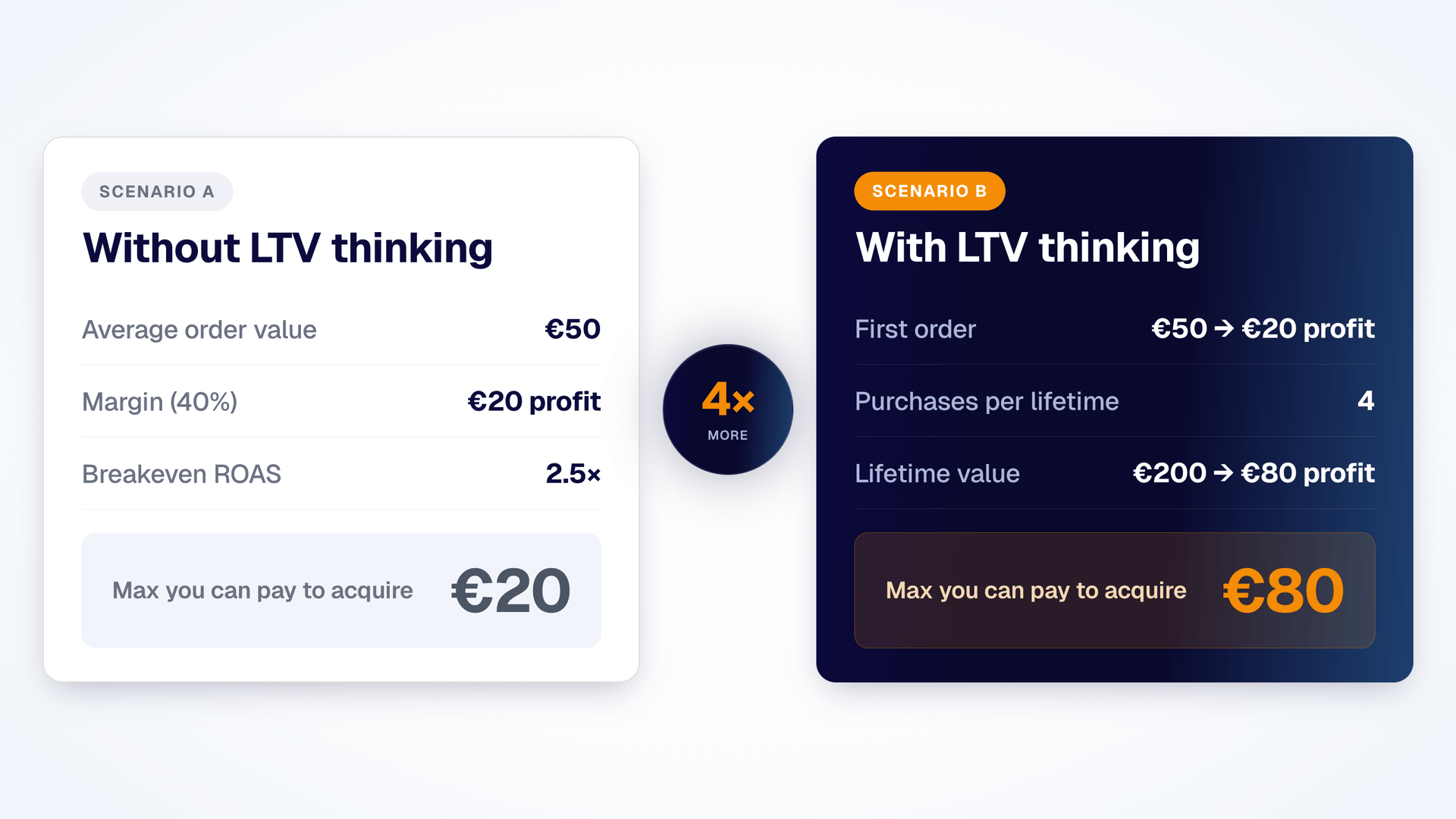
Suddenly you have room to 4x your bids… But this doesn’t mean you always bid 4x higher. It means you have more room to win auctions, and more room to pocket more profit per customer.
It’s a simplified, hypothetical example. But the point is true: businesses that understand LTV win the long-term game.
How low LTV stopped my client from scaling
I had a client that was incredible at acquiring customers.
We advertised on every channel imaginable — Google, YouTube, Meta, TikTok, Snapchat, Reddit, even TV.
The media strategy (and team!) was elite.
We scaled to hundreds of thousands of products sold in a few years, hitting $35M per year in revenue. A big brand with serious momentum.
On the surface, the numbers looked solid:
- CAC: €50
- AOV: €125
- ROAS: 250%
Pretty aggressive for an ecom brand.
But there was a big problem: profit margins under 10%, and an extremely low repeat purchase rate of 1.1.
That 1.1 meant almost nobody came back. One purchase, and that was it.
For this client, acquiring new customers was never the issue. They were great at it.
But they were stuck in a rat race: spend more to acquire new customers, push most of the profit back into ads, repeat forever.
And because there was no backend and no way to make customers worth more (LTV was basically the same as revenue), they couldn’t scale the way they wanted.
The biggest lesson I took from this client: you can’t out-acquire a broken LTV.
What we should have done was focus on repeat purchases and LTV — upsells, bundles, complementary products — instead of chasing more customers only.
The entire math would have changed, and we could have grown revenue and profit at the same time.
But the business model couldn’t support it. It was truly a one-off product you buy once and never again. It was more of a business problem than a Google Ads problem.
But still, that experience changed how I look at growth. Sometimes your next level doesn’t come from getting more customers but from making the customers you already have worth more.
And that’s why I’m making this plea for LTV.
Why LTV gets ignored
It’s not that people don’t understand LTV conceptually. It’s a simple concept. But:
- It’s harder to measure than CPA (most clients don’t track it properly)
- It takes longer to see results
- It feels like “someone else’s job” because it happens outside of Google Ads
So we default to what’s easy and immediate: optimizing campaigns, lowering CPAs, reporting on ROAS.
Those things are all important… But you’re not playing the game to its full potential when you’re only optimizing one variable (acquiring new customers) while ignoring the one that decides how big you can actually scale (making customers worth more).
How to increase LTV
You don’t need to become a retention expert. But you should understand the things that improve LTV:
- Increase transaction value: upsells, cross-sells, bundles, add-ons, premium tiers, ascensions, etc.
- Drive repeat purchases: email sequences, loyalty programs, rebuy reminders. Even if you don’t have a subscription model, you can get your customers to buy again in the future to increase LTV.
- Turn purchases into subscriptions: recurring revenue changes the whole math of acquisition (if the business model allows it).
- Reduce churn: for subscription businesses, cutting churn from 10% to 5% doubles average customer lifetime. Keep customer longer, make more profit.
Don’t be fooled by the technical terms. You just want to find out how to get existing customers to buy more and again (and again).
That is the flywheel that takes your results to the next level.
You don’t need to do all of this yourself. But you need to be aware of it, and you need to have these conversations with your clients, because it has a huge impact on your results.
Taking it further: gross profit and nCAC
If you want to get advanced, drop revenue-based metrics and refocus on new customers and profit data:
- Calculate your LTV on gross profit, not revenue. A €100 LTV at 80% margin is very different from €100 LTV at 20% margin. Always define LTV as gross profit to make it easier to analyze data properly and make the right decision.
- Calculate your nCAC (New Customer Acquisition Cost). This is CAC for new customers only — so you’re not counting returning customers who would have bought anyway as “acquisitions.” It shows what it actually costs to grow the business.
Then look at the ratio.
A 3:1 LTV:nCAC ratio (based on profit) is generally considered healthy:
- Below that, you’re spending too much relative to what customers are worth.
- Above that, you might be under-investing in growth.
But it truly depends on your business and goals.
This is how mature businesses think about acquisition
And if you can help your clients think this way, your value increases fast.
Anyone can set up a campaign with a target CPA or ROAS bid strategy these days.
But the specialists who help clients understand their unit economics — and focus on LTV alongside acquisition — will always be 10 steps ahead of those who only watch the in-platform CPA and ROAS.
They drive better results, so they can charge more — because they understand business growth, not just Google Ads account growth.
And that’s a very big competitive edge.
This is exactly what The PPC Hub is about
Our work is not just about growing Google Ads accounts.
It’s also about understanding LTV, unit economics, and the other things that impact business growth. That’s core to what we teach in The PPC Hub.
Inside, you’ll get the training (Google Ads Success Path), AI-powered systems (PPC OS), and community (2,400+ members) to build deep expertise, deliver the best results, and stay ahead — no matter how fast the industry changes.
If you want to be ahead of the curve, consider joining The PPC Hub.
It’s how we can help you the best.
That’s all for today, thank you for reading.
See you next week!
Cheers,
Miles (& Bob)


