
GM, Miles here!
There’s a framework I learned back in 2018, at my first agency job, that I still use on almost every account I build.
A mentor taught it to me, and it completely changed how I think about Google Ads strategy.
It’s super simple and it works almost every time. It shows you only only what campaigns to run, but also in what order.
Many agencies still propose top-down strategies. They start with awareness at the top of the funnel, spend big to get in front of cold audiences, and wait for it to trickle down into sales. Full-funnel and step-by-step.
Sounds great… But it’s actually very ineffective. It’s the slowest, riskiest way to start, especially with a new client or a small budget.
Today, I’ll show you a better way: the Bottom-Up Funnel. This allows you to drive results early by capitalizing on the interest that is already there.
This has been one of the most valuable frameworks I’ve learned in my career so far, and I hope you find value in it as well!
Let’s dive in!
Quick background on the traditional (outdated) See-Think-Do funnel.
The traditional See-Think-Do funnel looks like this:
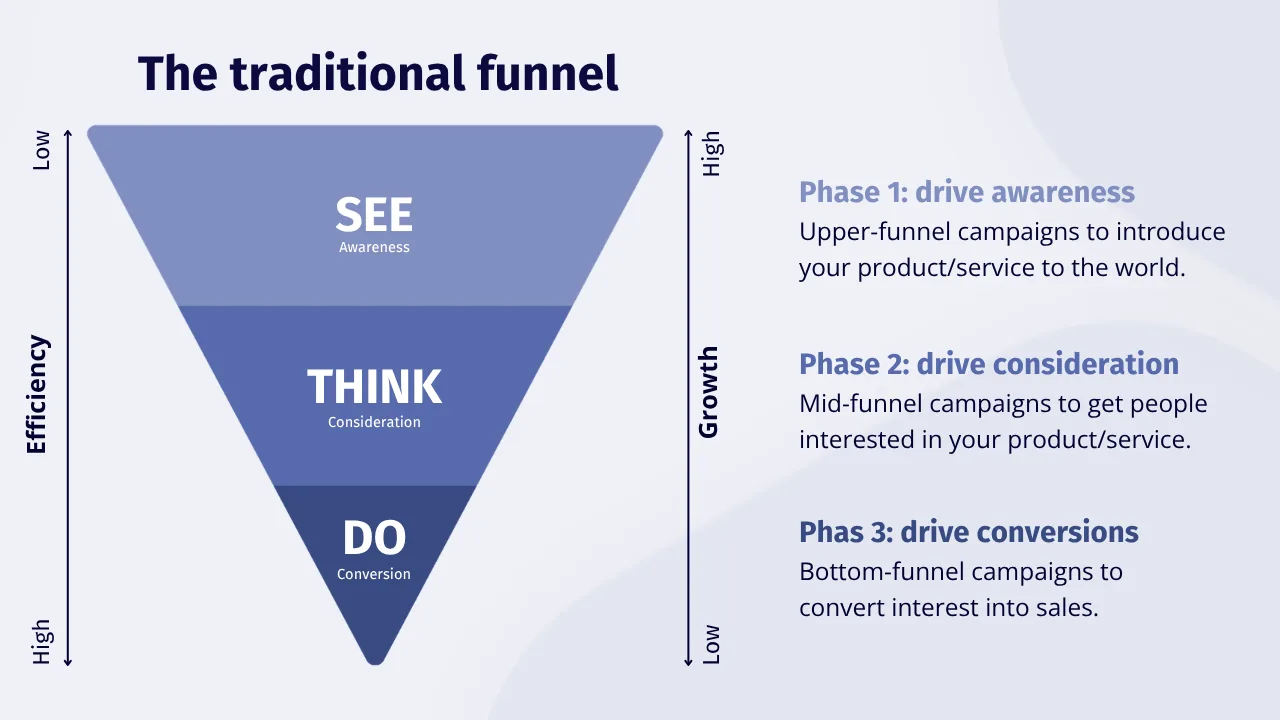
- See is awareness (ToFu): people who don’t know you yet.
- Think is consideration (MiFu): people weighing their options, researching solutions.
- Do is the bottom (BoFu): people actively searching, comparing, and ready to buy.
The standard advice is to cover the whole funnel: drive awareness first, create consideration second, and convert that interest into sales third.
But that’s inefficient and requires a lot of money (because top-funnel campaigns are expensive).
When you start at the top, you spend big on awareness for cold audiences who have a low chance of converting.
The results are slow and hard to attribute.
Flip the funnel: build from the bottom-up.
The Bottom-Up Funnel works the other way around:
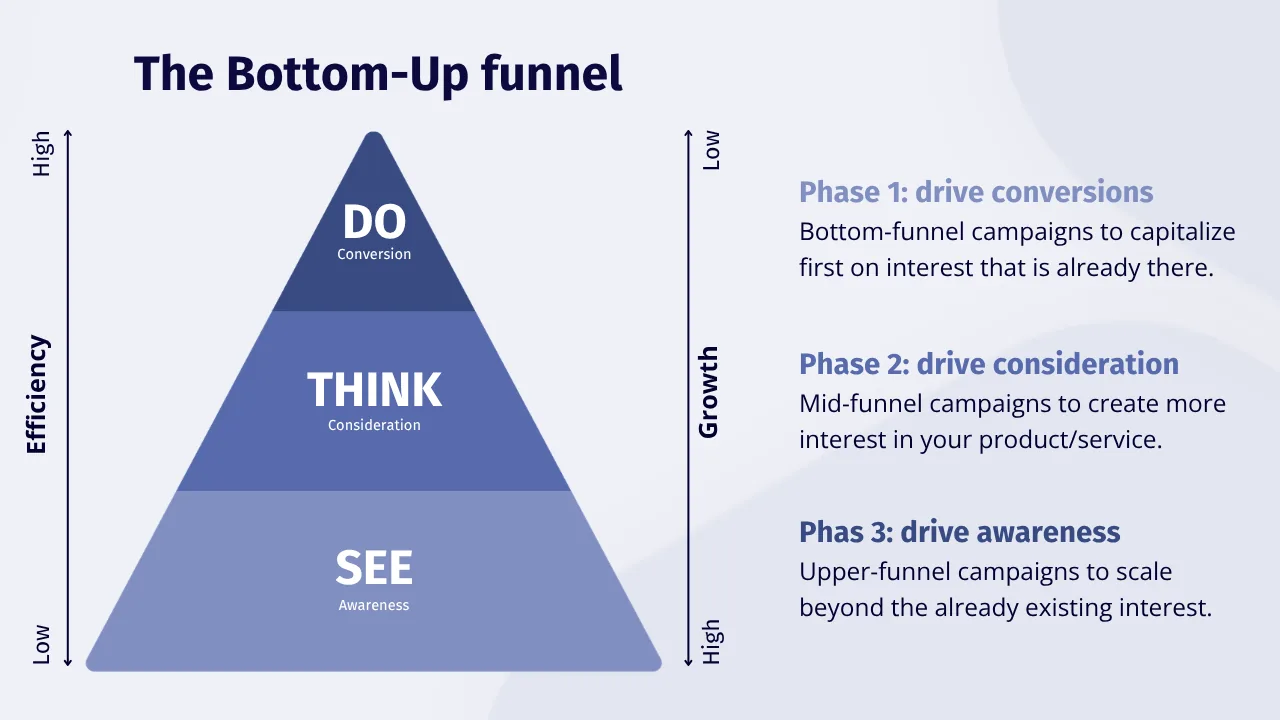
Start in the Do phase where the intent and the ROI are highest, max it out, then expand into Think, and only then scale into See. Each phase builds on a foundation that’s already proven it works.
You get results faster and your budget is spent much more efficiently from day 1.
Let’s unpack the framework below.
Phase 1 - Bottom of funnel: max out the foundation first.
The bottom of the funnel is your foundation. It’s everyone who could buy from you and is showing commercial intent right now: actively searching, comparing, shopping.
You want to start where success is almost guaranteed: the people who already want what you sell.
Your main campaign types here are:
- Search, maximizing keyword coverage on commercial-intent searches. This includes broad match and AI Max for relevant keyword expansion (as long as you pair them with Smart Bidding and strong negatives to minimize waste).
- Standard Shopping or feed-only pMax for ecom. Initially, you want to start with your best-performing products and categories that are proven to sell. As you grow, you can add more products.
Many businesses are perfectly fine advertising here forever. It is absolutely not a must to work your way up the funnel — you should only do this once you’ve maxed out the bottom of the funnel, or if your goals and budget require you to do so.
Phase 2 - middle of the funnel: expand into moderate commercial intent.
Once the bottom of the funnel is maxed out, you move up one level.
They call the middle of the funnel “messy” because there’s a large group of people who COULD buy from you but aren’t ready right now. They’re researching, comparing, learning. There is some interest, but not enough to convert immediately.
Intent is the keyword here. You’re not bidding on “emergency plumber near me” (immediate conversion signal). You’re showing up for “how to fix a leaking pipe” and “when do I actually need a plumber.”
These are people learning about the problem, considering options (including doing it themselves), and not yet thinking about transacting.
Here’s how to approach the middle of the funnel:
- Broader-intent keywords that capture research, not just ready-to-buy searches. You’ll typically see high CTR but lower CVR as most people are not thinking about buying anything yet. Send traffic to problem-solving blogs or videos with soft call to actions to your service/product.
- Demand Gen & Video on contextually relevant placements: banners on plumbing how-to sites, pre-roll on plumbing tutorial videos.
- Remarketing layered across those MiFu placements, so you stay in front of people who already visited your website and demonstrated interest.
It’s ok to still be performance-minded here, but you can’t expect these campaigns to drive the same conversions as your BoFu efforts. Keep in mind that you’ll probably have longer conversion windows. That’s just the nature of scaling beyond the bottom of the funnel.
Phase 3 - top of the funnel: scale to your whole market.
This is the top of the funnel, and it comes last for a reason.
This is where you can really scale, but it’s also the most expensive. You can theoretically target everyone in your market, regardless of intent. Most people don’t know or trust you, and most of the times they don’t even know they have a problem.
Converting them into buyers will require a LOT of content/convincing… It not only takes time, but it’s also very expensive.
This is where you create demand instead of capturing it by focusing on upper-funnel placements through Demand Gen and Video campaigns (and if you take off your Google Ads hat for a second, you’d also consider other channels like Meta Ads and even organic social).
You can’t judge these efforts on the same things as your BoFu or even MiFu campaigns. The impact of your ToFu efforts usually takes long to see. You’re really playing the long-game here.
If you’d started here, you’d have burned your budget quickly, waiting for conversions that may only start to show up 90-180 days later. That’s not an efficient marketing strategy if you ask me.
Instead, listen to Drake, and start from the bottom.
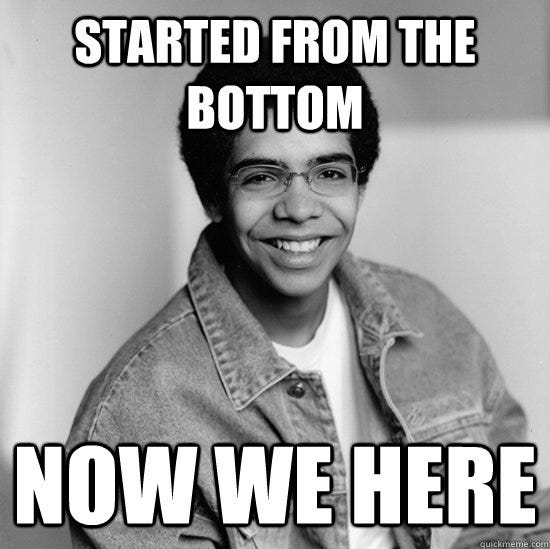
You get ROI fast because you target people who already want to buy, build confidence and trust with your client/boss because you’re hitting targets quicker, and you have a solid foundation to build upon.
When bottom-up doesn’t work (and what to do instead).
Time for a quick reality check: this isn’t a magical framework that works ALL THE TIME — there are always exceptions. It only works when there’s existing demand to capture. Here are some edge cases for when the Bottom-Up Funnel may not give you the best results:
1. New products or markets with no demand yet. Nobody’s searching, so there’s no bottom to start from. Awareness and education have to come first. You create the demand before you can capture it.
2. High-consideration products with long sales cycles (6-12 months). Some customers need a lot of nurturing before they buy. B2B SaaS or high ticket products are classic examples of when you need a lot of touchpoints before you get to a conversion. Focusing on BoFu only will probably limit you in such a case and you would have to do more than just that to drive sales.
3. Saturated markets. When BoFu CPCs are so high that your efficiency targets are impossible to hit, you may need to go up the funnel faster to try and compete outside of the expensive transaction-focused bottom of the funnel.
4. Brand-building or awareness goals. This one speaks for itself but if you goal is to drive awareness or build a brand, your focus should not be on the bottom of the funnel but on the mid and upper funnel.
The key takeaway: maximize the bottom of the funnel first.
Whatever the case, the logic stays the same: whenever you can, try to capitalize on existing demand that is already there (which is usually in the bottom of the funnel).
It’s the most efficient and effective way to grow, especially early or when you’re working with small budgets.
If you want to stop guessing how to approach your account’s strategy and start driving the best results reliably, we’d love to help you go deeper in The PPC Hub.
Inside, you’ll get access to the training, AI-powered systems, and community to build deep expertise, deliver the best results, and stay ahead — no matter how fast the industry changes.
If you want to level up your game, consider joining The PPC Hub — it’s how we can help you most.
That’s all for today, thank you for reading.
See you next week!
Cheers,
Miles (& Bob)


